Links
Important Dates
Last date for full Submission Deadline:
September 30, 2026
Last date for full Notification of Acceptance:
October 10, 2026
Last date for full Camera Ready Submission:
October 20, 2026
Contact Us
Conference Secretary
cavi@acamail.org
CAVI 2026 was Successfully Held on October 30!
Time: 2026-11-02
The 2026 International Conference on Connected and Autonomous Vehicles and Vehicle-Infrastructure Integration (CAVI 2026) was successfully held on October 30, 2026 online. CAVI 2026 is Support by Zhengzhou University of Light Industry, China and University of Technology and Arts in Applied Sciences in Warsaw. Through diverse forms including keynote speeches and achievement sharing, participants showcased the latest research advances and innovative outcomes in connected and autonomous vehicles and vehicle-infrastructure integration. They exchanged views on emerging industry trends, prevailing challenges and feasible breakthrough approaches, gaining frontier insights to fuel the innovative development of this discipline.
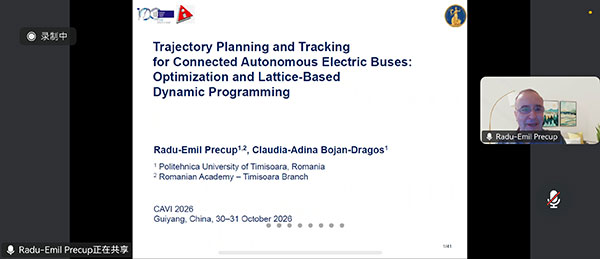
In the keynote speeches session, Radu-Emil Precup, Professor of the Politehnica University of Timisoara, Romania, delivered a keynote speech titled "Trajectory Planning and Tracking for Connected Autonomous Electric Buses: Optimization and Lattice-Based Dynamic Programming".
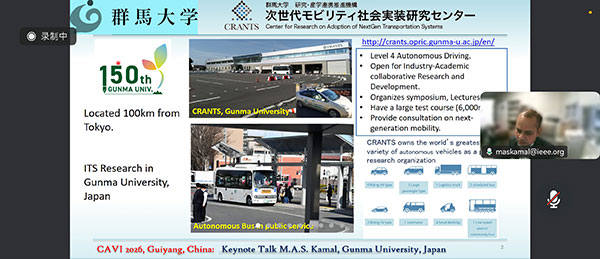
Md Abdus Samad Kamal, Associate Professor of Gunma University, Japan, presented a keynote speech titled "Cooperative Intersection Traffc Managemnent for Efhcient Human-CAVIntegratien".
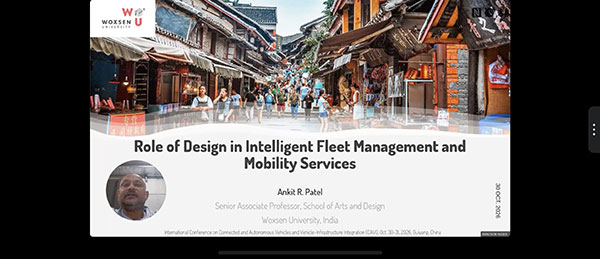
Ankit R. Patel, Senior Associate Professor of Woxsen University, India, gave a keynote speech titled "Role of Design in Intelligent Fleet Management and Mobility Services".
The conference offered a professional platform for scholars engaged in connected and autonomous vehicles and vehicle-infrastructure integration to present research findings and exchange academic insights. Moving forward, CAVI will continue to focus on frontier research topics in this field, foster the exchange of theoretical breakthroughs and technological innovations among global researchers, deepen international research collaboration, accelerate the translation of advanced technologies from laboratory studies into engineering deployment and industrial practice, and jointly drive the sustainable development of intelligent transportation systems.